

Recently I read a thought-provoking essay by writer Christopher August titled “The Timeline Split and the New Earth.” His piece explores something many people quietly feel right now. Life seems to be accelerating. Events unfold rapidly. Old structures appear to be under strain while new possibilities begin to emerge.
August describes this moment as a kind of “quickening,” a period in which humanity is moving through a transition in consciousness. Whether one views this idea spiritually, symbolically, or philosophically, the questions he raises are worth reflecting on.
Rather than reproducing his article in full, I want to respond to several of the reflection questions he offers at the end of his essay. They provide a meaningful framework for thinking about the kind of world we are helping to create.
Why Christopher August’s Essay Resonates
One reason August’s writing resonates with so many readers is that it speaks to a feeling that is difficult to describe. Many people sense that the world is changing rapidly. Political tensions, technological acceleration, environmental challenges, and cultural shifts all contribute to the sense that we are living through a turning point.
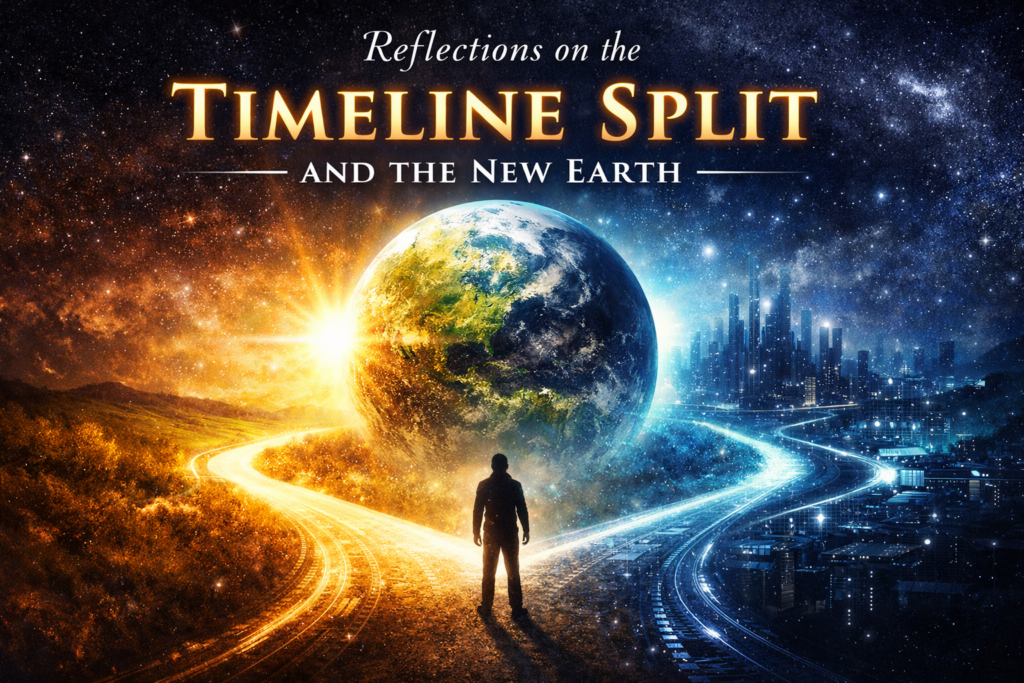
In his essay, August suggests that humanity may be approaching a crossroads between two possible paths. One path emphasizes control, technological dominance, and centralized systems. The other emphasizes consciousness, cooperation, and a deeper relationship with the natural intelligence of life.
Whether or not one agrees with every aspect of this vision, the deeper invitation is clear. Each person can ask how they wish to participate in shaping the future.
Fear or Love: What Guides Our Decisions?
One of August’s central themes is the contrast between fear and love as forces that shape human behavior.
He writes:
“Fear contracts. It isolates and separates. Love expands. It connects and unites.”
— Christopher August
When we look closely at our own lives, this distinction becomes surprisingly practical. Fear often appears as anxiety, defensiveness, or the urge to control outcomes. It narrows our thinking and keeps us focused on survival.
Love has the opposite effect. It encourages openness, creativity, and collaboration. It allows us to step back from immediate reactions and respond with greater awareness.
Reflecting on this question reveals how often small decisions are shaped by subtle fears. Yet each moment also offers an opportunity to choose a more expansive response.
Organic Intelligence and the Future of Humanity
Another idea in August’s essay is the concept of “organic intelligence.” He contrasts this with the rapidly expanding world of artificial intelligence and algorithmic systems.
According to August, the human being itself is an extraordinary form of intelligence. Our nervous system, intuition, emotional awareness, and capacity for empathy represent forms of knowledge that cannot easily be reduced to data.
Technology is not inherently harmful. In many ways it improves our lives and connects us across vast distances. The deeper question is whether technology serves human consciousness or gradually replaces it.
Organic intelligence can be understood as the ability to remain connected to our own inner guidance. It includes intuition, compassion, and the quiet wisdom that arises when we pause long enough to listen.
How Individuals Help Anchor a New Earth
One of the most interesting questions August asks is how individuals can help “anchor” the vibration of a new world.
This shifts the conversation away from speculation about global events and toward personal participation. Instead of waiting for large systems to change, each person can contribute through the quality of their actions.
Artists, writers, teachers, healers, and community builders all influence the cultural atmosphere around them. Even simple acts of kindness and honesty help shape the social environment in which we live.
In this sense, creating a “New Earth” may not require dramatic transformation. It may grow gradually through millions of individual choices that favor awareness, cooperation, and compassion.
Imagining the World We Are Creating
August also invites readers to imagine what a more harmonious world might look and feel like.
When I reflect on this question, I imagine communities where people feel connected rather than isolated. I imagine technology used responsibly, supporting creativity rather than controlling behavior. I imagine systems that reward transparency, cooperation, and service.
Imagination is powerful. Many of the greatest changes in history began as ideas that seemed unrealistic at first. The future often begins as a picture in someone’s mind.
When people share similar visions of possibility, those ideas slowly begin to influence the structures of society.
Living Today as if the New Earth Already Exists
Perhaps the most practical reflection question August asks is this:
How can we live today as if that better world already exists?
Large global issues can feel overwhelming. Yet the daily choices we make carry real influence. The way we treat other people, the integrity we bring to our work, and the attention we give to our inner life all contribute to the culture around us.
Living as if a more conscious world already exists does not require perfection. It simply requires awareness and intention.
Small actions accumulate. Over time they shape the character of communities, institutions, and societies.
Final Thoughts on the Timeline Shift
Christopher August’s essay speaks to a feeling shared by many people across different backgrounds and beliefs. The sense that humanity may be standing at an important turning point.
Whether one interprets his ideas spiritually, symbolically, or psychologically, the underlying message remains hopeful. The future is not determined solely by external forces. It is also shaped by the choices individuals make each day.
Fear or love. Separation or connection. Control or cooperation.
Each moment offers an opportunity to move the world slightly in one direction or another.
Perhaps the most important realization is that the future does not suddenly arrive one day. It is created gradually through countless small decisions made by ordinary people who choose to live with awareness, courage, and compassion.
This article reflects on ideas presented in Christopher August’s essay “The Timeline Split and the New Earth” (October 7, 2025). Readers interested in the full perspective are encouraged to seek out the original piece.